Dental Implants: Your Complete Patient Guide (2026)

Everything you need to know about dental implants — from candidacy and procedure steps to recovery, costs, and choosing the right clinic in Noida.
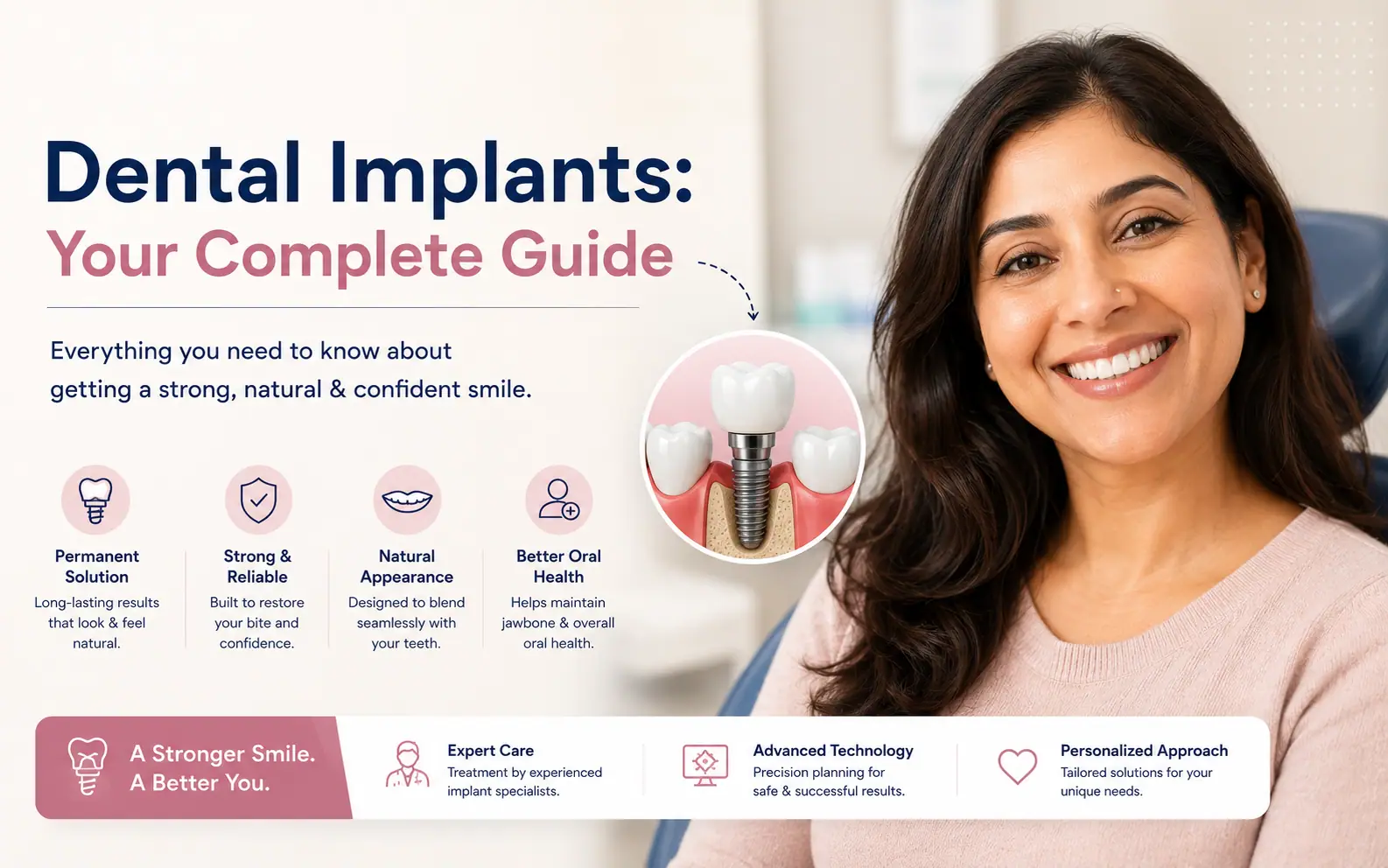
What is a dental implant?
A dental implant is a small titanium post surgically placed into the jawbone to act as an artificial tooth root, supporting a crown, bridge, or denture above the gum line. The single most-asked question patients have is simply: will this feel like a real tooth? The short answer is yes — more closely than any other tooth-replacement option available today.
Unlike removable dentures or conventional bridges, an implant integrates directly with living bone through a biological process called osseointegration. The result is a restoration that is fixed, comfortable, and designed to function like a natural tooth.
Who needs dental implants?
Dental implants are appropriate for a broad range of patients, but they are particularly well suited to those who:
- Are missing one or more teeth due to decay, gum disease, trauma, or failed root canal treatment
- Have a complete denture that is unstable or uncomfortable
- Want to avoid grinding down healthy adjacent teeth (as a conventional bridge requires)
- Have adequate bone volume and density in the jaw — or are willing to undergo bone grafting where needed
- Are in good general health with well-controlled systemic conditions
Age is rarely a barrier once jawbone growth is complete (typically in the late teens). Uncontrolled diabetes, active periodontal disease, heavy smoking, and certain medications affecting bone density can complicate outcomes, so a thorough medical and dental assessment always comes first.
If you have recently lost a tooth to injury, you may also want to read our emergency guide for a knocked-out tooth — early action can sometimes preserve the natural tooth and avoid the need for an implant altogether.
Types of implant-supported restorations
Not all implant treatment is the same. The restoration placed on top of the implant varies based on how many teeth are missing and the state of the remaining dentition.
Single-tooth implant
One implant post supports one custom crown. This is the most common scenario and the closest equivalent to replacing a single natural tooth without affecting neighbouring teeth.
Implant-supported bridge
Two implants anchor a bridge spanning three or more missing teeth. This avoids the need to cut down healthy teeth on either side of the gap, which is a significant advantage over conventional bridgework.
Implant-retained denture (overdenture)
Two to four implants provide secure anchorage points for a removable denture. Stability and chewing efficiency improve substantially compared with a conventional denture.
Full-arch fixed restoration (All-on-4 / All-on-6)
Four to six strategically placed implants support a full arch of fixed teeth. This approach is increasingly chosen by patients facing complete tooth loss or extensive rehabilitation. Our full guide on full-mouth rehabilitation covers when this level of treatment is genuinely warranted.
What to expect: the treatment journey
Implant treatment typically unfolds across several appointments over a period of months. Here is a realistic overview.
Initial consultation and planning
Your dentist will take digital X-rays and, where necessary, a cone-beam CT scan to assess bone volume and proximity to anatomical structures such as the sinus or inferior alveolar nerve. Medical history, medications, and oral health are reviewed in full.
Preparatory procedures (if required)
Some patients need bone grafting, a sinus lift, or gum disease treatment before implant placement. Addressing active periodontal disease first is not a delay — it is essential for long-term success. Early signs of gum disease are often missed; if your dentist raises this at consultation, take it seriously.
Implant placement
The titanium post is placed under local anaesthesia in a minor surgical procedure. Most patients report the experience is comparable to a straightforward tooth extraction — uncomfortable, but manageable. Sedation options are available for anxious patients.
Osseointegration (healing phase)
Over the next eight to twelve weeks (sometimes longer for grafted sites), the implant fuses with the jawbone. A temporary restoration may be provided during this phase.
Abutment and crown placement
Once integration is confirmed, a connecting piece (abutment) is attached and a final custom crown, bridge, or denture is fitted. Shade, shape, and fit are refined to match your natural dentition.
Recovery: what the timeline actually looks like
Immediate post-surgical discomfort — swelling, mild aching, and some bleeding — typically peaks within 48–72 hours and resolves within a week for most patients. Soft foods, gentle rinsing, and avoiding smoking during healing are standard instructions.
The longer healing phase (osseointegration) is largely invisible from the outside; daily life is not significantly disrupted. Our dedicated post on the dental implant recovery timeline goes into considerably more detail about what to expect week by week, including which symptoms warrant a call to your dentist.
Key recovery milestones at a glance:
- Day 1–3: Swelling and soreness; rest, cold compresses, prescribed pain relief
- Week 1–2: Soft diet; avoid vigorous exercise and smoking
- Week 3–8: Gradual return to normal diet; implant integrating below the surface
- 3–6 months: Review appointment; final restoration placed if integration is confirmed
Cost overview
Dental implant costs in India vary based on the number of implants, the implant brand and materials used, whether bone grafting is needed, and the complexity of the final restoration. As a general principle, implant treatment is an investment — but when evaluated over a decade or more, it frequently compares favourably with repeated replacement of bridges or dentures.
For a detailed, up-to-date breakdown of what to expect financially, see our dedicated article on dental implant cost in Noida in 2026, which covers per-implant pricing, additional procedure costs, and what questions to ask at your consultation.
A few things worth knowing:
- Always ask for an itemised treatment plan before consenting
- Quotes that seem unusually low often exclude crown fabrication, abutment, or grafting fees
- Many clinics offer structured payment arrangements — ask about this openly
How long do dental implants last?
With good oral hygiene and regular professional maintenance, implants placed to clinical guidelines can last many decades. The implant post itself has a high long-term survival rate in published evidence; the crown on top may need replacement after ten to fifteen years depending on wear and the forces placed on it.
Factors that shorten implant life include smoking, uncontrolled diabetes, poor home care, and bruxism (tooth grinding). For an evidence-based deep dive into implant longevity, read how long a dental implant actually lasts.
Risks and complications
Dental implants have a strong safety record, but they are a surgical procedure and carry real risks that every patient should understand.
Short-term risks:
- Infection at the surgical site
- Bleeding or haematoma
- Temporary nerve sensitivity or altered sensation
- Implant failure to integrate (uncommon with adequate bone and good technique)
Long-term risks:
- Peri-implantitis — a form of gum disease around the implant that can lead to bone loss if untreated
- Mechanical issues such as crown fracture or abutment screw loosening
- Bone resorption, particularly in smokers or patients with metabolic conditions
Our MDS specialists in oral and maxillofacial surgery and periodontology discuss these risks explicitly at consultation; an informed patient is better placed to make decisions and to follow aftercare instructions that reduce their likelihood.
Choosing the right clinic
Choosing a clinic for implant treatment deserves as much care as the treatment itself. Here is what matters most.
Specialist involvement: Implant placement ideally involves a dentist with postgraduate training in oral surgery or implantology (MDS or equivalent recognised qualification). Complex cases — multiple missing teeth, grafting, full-arch rehabilitation — benefit from a multi-speciality team approach.
Diagnostic technology: A clinic offering cone-beam CT scanning can plan implant placement with precision and reduce the risk of anatomical complications. This is not optional for complex cases.
Transparency: A reputable clinic will provide a written, itemised treatment plan and take time to explain every stage. Pressure to decide quickly or vague pricing are warning signs.
Follow-up and maintenance: Implants need long-term maintenance. Check whether the clinic has a clear recall programme and is accessible for follow-up.
Published clinical protocols: Clinics following evidence-based guidelines from bodies such as the International Team for Implantology (ITI) or equivalent professional organisations tend to deliver more consistent outcomes.
Local considerations for Noida patients
Patients living and working in Noida benefit from access to multi-speciality dental care without travelling to central Delhi. Dental Care Centre in Sector 78 brings together MDS-qualified specialists across implantology, periodontics, prosthodontics, and oral surgery under one roof — which matters when treatment requires input from more than one discipline, as implant cases often do.
Noida's expanding residential sectors have also brought a growing number of dental clinics to the area, ranging in quality and experience. When evaluating your options, prioritise clinics that can demonstrate cone-beam CT capability, in-house specialist teams, and a transparent written treatment plan — rather than making decisions on price alone.
For patients travelling from outside India for treatment, our resource on dental tourism in Noida covers what international and non-resident Indian patients should know before booking.
Frequently asked questions
Is the implant procedure painful?
Most patients are surprised by how manageable the procedure is under local anaesthesia. Post-operative discomfort is typically controlled with standard over-the-counter pain relief for the first two to three days. Patients who are particularly anxious can discuss conscious sedation options at their consultation.
How many appointments will I need?
In most cases, implant treatment involves four to six appointments spread over three to six months, though this varies with the complexity of the case. Patients who need bone grafting or treatment for gum disease will need additional visits before implant placement.
Can I have an implant if I have diabetes?
Well-controlled diabetes is generally not a contraindication to implant treatment; uncontrolled diabetes significantly increases the risk of infection and implant failure. Your medical status will be reviewed at consultation and, in some cases, liaison with your physician is recommended before proceeding.
What happens if an implant fails?
Implant failure (the implant failing to integrate or becoming mobile) is uncommon but does occur. In most cases, the implant can be removed, the site allowed to heal, and a second attempt made — sometimes with additional bone grafting. Our MDS team reports that re-treatment success rates are reasonable in appropriately selected patients.
Do implants look natural?
Yes. Modern ceramic crowns on implants are fabricated to match the shade, shape, and translucency of natural teeth. In most clinical situations, implant-supported crowns are indistinguishable from natural teeth to a casual observer.
Will my NHS or private insurance cover implant treatment in India?
Dental implants are rarely covered under standard insurance plans, whether in India or abroad. However, some corporate health plans and international dental insurance policies do include implant coverage with prior authorisation — it is worth checking your policy documents carefully before your consultation.
A note from our team
This article is intended as general educational information about dental implants and does not substitute for a clinical assessment of your individual case. Suitability for implant treatment depends on factors that can only be evaluated in person, including your bone volume, medical history, and oral health. We encourage you to use this guide as a starting point for an informed conversation with a qualified dentist. If you would like to discuss your specific situation, you are welcome to book a consultation with our specialist team at Dental Care Centre, Sector 78, Noida.
Free 15-minute consultation. We'll review your specific case and walk you through your options — no pressure, no upselling.
Treatments mentioned in this article
More from the Blog
All 23 articles →
Why Regular Dental Check-ups Are Essential for a Healthy Smile
Regular dental check-ups help prevent cavities, gum disease, and costly treatments. Learn why visiting your dentist every six months matters.
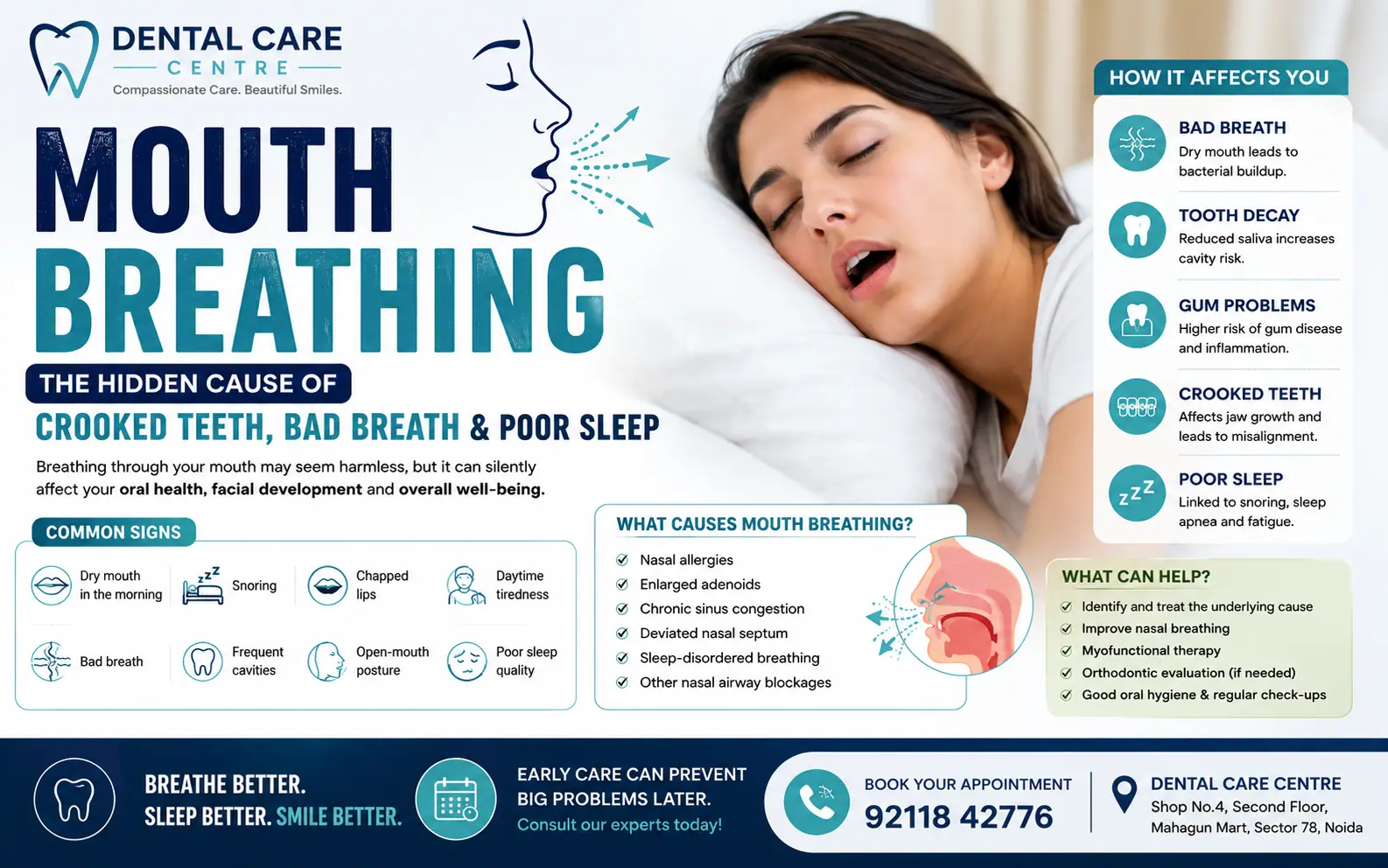
Mouth Breathing: The Hidden Cause of Crooked Teeth, Bad Breath & Poor Sleep
Mouth breathing can affect more than just your sleep. Learn how it contributes to bad breath, gum disease, crooked teeth, and facial development—and what you can do about it.

Invisible Aligners: Your Complete Patient Guide
Everything you need to know about invisible aligners — how they work, who qualifies, what treatment involves, costs, and how to choose the right clinic.